Endocrinology
1947
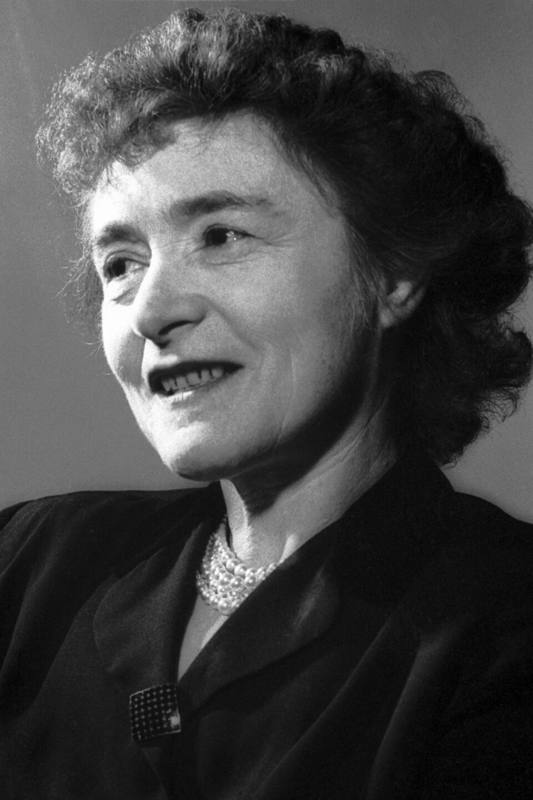
Gerty and Carl Cori and glycogen
From 1922 Gerty and Carl Cori worked out how the body stores and releases sugar as glycogen: the Cori cycle, glucose-1-phosphate and the enzyme phosphorylase. Their shared 1947 Nobel Prize made Gerty Cori the first woman to win the prize for medicine.
Key people
- Gerty T. Cori
- Biochemist; first woman awarded the Nobel Prize in Physiology or Medicine
- Carl F. Cori
- Biochemist; chairman of pharmacology at Washington University from 1931
- Sidney Colowick
- Graduate student who helped characterize the Cori ester
- Arda Green
- Co-crystallized muscle phosphorylase with the Coris, 1942 to 1943
Source
Carl Cori and Gerty Radnitz studied medicine together at the German University of Prague, graduated in 1920 and married the same year. Life in postwar Europe was hard, and as a Jewish woman Gerty had little chance of an academic post; at one point they applied to work as doctors in Java. In 1922 Carl took a job as biochemist at the State Institute for the Study of Malignant Disease in Buffalo, New York. Gerty followed six months later as an assistant pathologist and was told she would lose the job if she strayed from her own laboratory in the pathology department.
In Buffalo they asked how the body keeps blood sugar steady. Insulin, they found, increased the conversion of glucose to glycogen in muscle and liver, and epinephrine did the reverse. Since muscle glycogen does not feed blood glucose directly, they proposed and then showed that muscle breaks glycogen down to lactic acid, which the blood carries to the liver to be rebuilt and sent back as glucose. They drew this cycle of carbohydrates, now the Cori cycle, in 1929.
In 1931 Carl became chairman of pharmacology at Washington University School of Medicine in St. Louis. Gerty joined as a research associate on one tenth of his salary. In 1936, working with minced frog muscle, they isolated a new product of glycogen breakdown, glucose-1-phosphate, soon called the Cori ester. With their student Sidney Colowick they fixed its structure and found the enzyme that forms it, phosphorylase. Run backward, the reaction built glycogen, the first biological macromolecule made in a test tube. In papers of 1942 and 1943 they and Arda Green crystallized muscle phosphorylase.
The Coris shared the 1947 Nobel Prize in Physiology or Medicine with Bernardo Houssay of Argentina. Gerty Cori was the first woman to receive it, and that year she was made professor of biochemistry. Seven future Nobel laureates worked in their St. Louis laboratory.
In the summer of 1947, on a climbing trip in the Rockies, the Coris learned that Gerty had an incurable bone marrow disease. She kept working for ten years, studying the enzyme defects behind different forms of glycogen storage disease and describing a debranching enzyme with Joseph Larner. She died on 26 October 1957.
Keep exploring
 Read next · built on
Discovery of Insulin (1922)
The Coris found that insulin speeds the conversion of glucose to glycogen in muscle and liver. The insulin story shows the extract that first brought down a diabetic child's blood sugar.
Read this moment
Read next · built on
Discovery of Insulin (1922)
The Coris found that insulin speeds the conversion of glucose to glycogen in muscle and liver. The insulin story shows the extract that first brought down a diabetic child's blood sugar.
Read this moment
 Today on The Clinical Times
Love to Dream recalls portable baby sound machine over fire and burn risk
Love to Dream has recalled its portable Sleep Machine because its lithium-ion battery can overheat while charging with an incompatible charger, creating a risk of fire and burns.
Read today’s top stories
Today on The Clinical Times
Love to Dream recalls portable baby sound machine over fire and burn risk
Love to Dream has recalled its portable Sleep Machine because its lithium-ion battery can overheat while charging with an incompatible charger, creating a risk of fire and burns.
Read today’s top stories
All 526 moments in the history of medicine. This one is in chapter 5, Cures and codes
Connected moments
How this moment links to others in the history of medicine, and what you will find in each.
-
 Same disease or problem1937Krebs and the citric acid cycleBoth mapped how cells handle fuel, the Coris for storing sugar as glycogen and Krebs for burning it. Krebs's story shows the loop of acids that regenerates itself at every turn.Read this moment
- Same disease or problem1776Dobson's experiments on diabetic urineThe Coris asked how the body keeps blood sugar steady, and Dobson first showed that diabetic sugar sits in the blood. His story shows diabetic urine evaporated to a sugary cake.Read this moment