Cardiology
c. 1903
Einthoven's Electrocardiograph
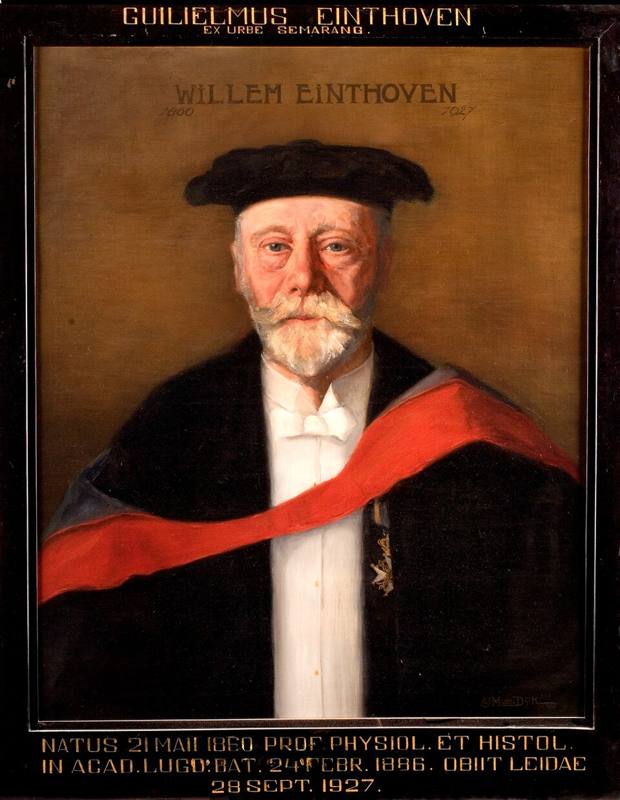
Willem Einthoven's string galvanometer, built at Leiden between 1901 and 1903, recorded the heart's electrical activity well enough for clinical use. His P to T wave names and three-lead triangle are still in use, and he won the 1924 Nobel Prize.
Key people
- Willem Einthoven
- Leiden physiologist who built the string galvanometer; Nobel 1924
- Augustus Waller
- St Mary's physiologist who recorded the first human electrocardiogram
Source
The heart's electrical activity had been recorded before Willem Einthoven, but only crudely. Augustus Waller of St Mary's Medical School in London published the first human electrocardiogram in 1887, using a capillary electrometer with electrodes on the chest and back. In 1891 William Bayliss and Edward Starling at University College London showed three phases of electrical activity in each beat with an improved electrometer.
Einthoven, a physiologist at Leiden University who had been born in Java in 1860, refined the capillary electrometer and picked out five deflections in each beat, which he labeled ABCDE. Once the tracing was corrected for the sluggishness of the instrument, he renamed them P, Q, R, S and T. He had introduced the word electrocardiogram at a Dutch medical meeting in 1893.
He then built a new instrument. His string galvanometer, developed in 1901, was highly sensitive, and the complete apparatus weighed about 600 pounds. AlGhatrif and Lindsay date the electrocardiograph's introduction to medicine to 1902; the Nobel Foundation dates Einthoven's construction of the string galvanometer to 1903.
Einthoven also simplified the recording. He cut the number of electrodes to three by dropping the right leg and mouth electrodes, which he judged least useful, and the three leads that remained formed the arrangement still taught as Einthoven's triangle. With the chest X-ray, introduced in 1895, the electrocardiograph gave physicians objective information about the heart's structure and function. Einthoven received the 1924 Nobel Prize in Physiology or Medicine for his discovery of the mechanism of the electrocardiogram.
Keep exploring
 Read next · same disease or problem
Laennec's stethoscope (1816)
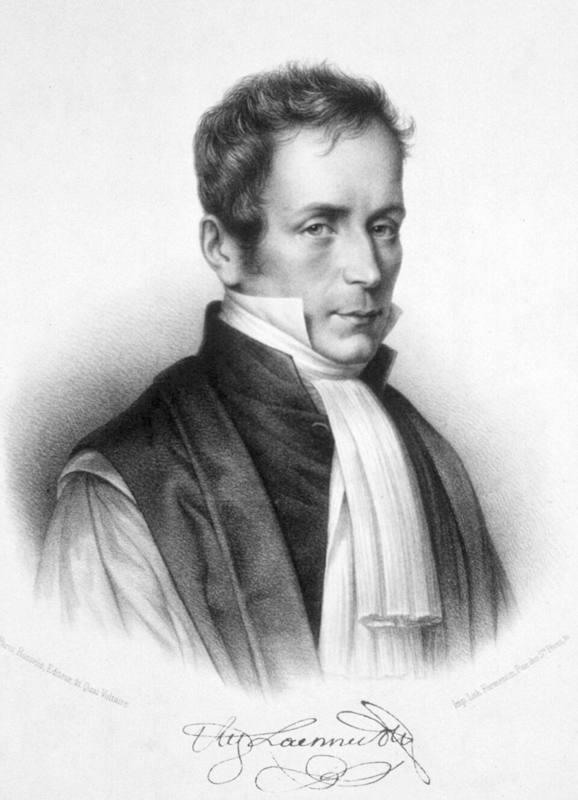
Both gave doctors an instrument for diagnosing heart disease, Laennec a tube to hear it and Einthoven a machine to record its electrical activity. Laennec's story shows the rolled paper cylinder that became the stethoscope.
Read this moment
Read next · same disease or problem
Laennec's stethoscope (1816)
Both gave doctors an instrument for diagnosing heart disease, Laennec a tube to hear it and Einthoven a machine to record its electrical activity. Laennec's story shows the rolled paper cylinder that became the stethoscope.
Read this moment
 Today on The Clinical Times
Love to Dream recalls portable baby sound machine over fire and burn risk
Love to Dream has recalled its portable Sleep Machine because its lithium-ion battery can overheat while charging with an incompatible charger, creating a risk of fire and burns.
Read today’s top stories
Today on The Clinical Times
Love to Dream recalls portable baby sound machine over fire and burn risk
Love to Dream has recalled its portable Sleep Machine because its lithium-ion battery can overheat while charging with an incompatible charger, creating a risk of fire and burns.
Read today’s top stories
All 526 moments in the history of medicine. This one is in chapter 5, Cures and codes
Connected moments
How this moment links to others in the history of medicine, and what you will find in each.
-
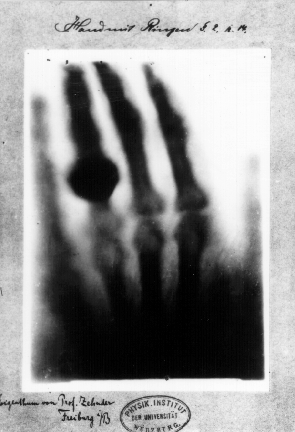 Same disease or problem1895Roentgen's discovery of X-raysWith the chest X ray, the electrocardiograph gave physicians objective information about the heart. Roentgen's story shows the rays that let doctors see inside a living patient.Read this moment
-
 Same disease or problem1958First implantation of a permanent cardiac pacemaker (Senning and Elmqvist)Einthoven recorded the heart's electrical activity, and the pacemaker supplied it when the heart's own rhythm failed. The pacemaker story shows Arne Larsson living with implanted devices from 1958 until 2001.Read this moment