Epidemiology
1941
Gregg's discovery of congenital rubella
In 1941 the Sydney ophthalmologist Norman Gregg linked an unusual number of babies born with cataracts to German measles in their mothers during pregnancy. Later studies confirmed that this usually mild infection could cause serious birth defects.
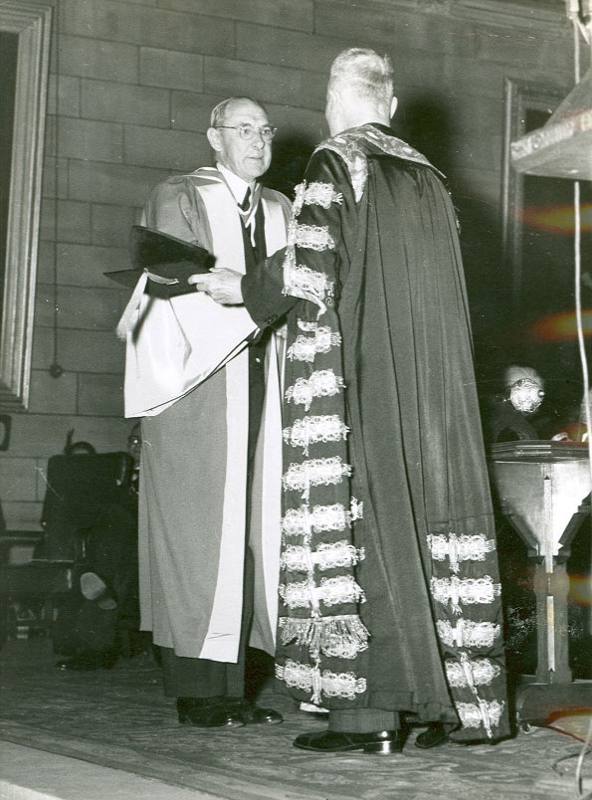
Key people
- Norman McAlister Gregg
- Sydney ophthalmologist who linked maternal rubella to congenital cataract
Source
In the first half of 1941 an unusual number of babies with congenital cataracts appeared in Sydney. Norman Gregg (1892 to 1966), an ophthalmologist, was seeing two to three times the number that hereditary causes would explain. A severe epidemic of German measles, or rubella, had struck Australia in 1940. It swept through army training camps, and young men home on leave carried it to their families.
Gregg overheard mothers of affected babies talking about having had German measles while pregnant. He went through the records of children with the condition: of 78 babies with cataracts, 13 of them his own patients, 68 had been exposed to rubella in the womb. He did not examine the babies with a slit lamp, judging that he could not justify an anesthetic long enough for it. On 15 October 1941 he read his paper, Congenital Cataract following German Measles in the Mother, to the Ophthalmological Society of Australia in Melbourne, and it appeared in the society's Transactions. It stressed cataracts and congenital heart disease.
Sydney's popular press reported the paper on a Monday morning. Before lunch two mothers had telephoned him: they had had rubella early in pregnancy, and their children were deaf but had none of the defects he had listed. Gregg went on to publish Further Observations on Congenital Defects in Infants following Maternal Rubella. His findings were praised in Australia, but many of his peers abroad were not convinced at first.
Later studies confirmed his observations. Rubella, long regarded as a mild infection, could cause cataracts and other serious birth defects if a susceptible woman caught it in the first few months of pregnancy. The finding spurred rapid growth in teratology, the study of the causes of birth defects, and offered hope of preventing some of them.
Keep exploring
 Read next · led to
Rubella epidemic and the rubella vaccine (1964)
Gregg first tied rubella in pregnancy to birth defects, and the 1964 epidemic showed that harm on a vast scale. That story shows 20,000 American babies born with congenital rubella before vaccines were licensed in 1969.
Read this moment
Read next · led to
Rubella epidemic and the rubella vaccine (1964)
Gregg first tied rubella in pregnancy to birth defects, and the 1964 epidemic showed that harm on a vast scale. That story shows 20,000 American babies born with congenital rubella before vaccines were licensed in 1969.
Read this moment
 Today on The Clinical Times
Love to Dream recalls portable baby sound machine over fire and burn risk
Love to Dream has recalled its portable Sleep Machine because its lithium-ion battery can overheat while charging with an incompatible charger, creating a risk of fire and burns.
Read today’s top stories
Today on The Clinical Times
Love to Dream recalls portable baby sound machine over fire and burn risk
Love to Dream has recalled its portable Sleep Machine because its lithium-ion battery can overheat while charging with an incompatible charger, creating a risk of fire and burns.
Read today’s top stories
All 526 moments in the history of medicine. This one is in chapter 5, Cures and codes
Connected moments
How this moment links to others in the history of medicine, and what you will find in each.
-
 Same disease or problem2016Zika virus and congenital microcephalyGregg showed that a mild infection in pregnancy could harm the baby, and in 2016 Zika was found to cause microcephaly. The Zika story shows WHO declaring an international emergency.Read this moment
-
 Same disease or problem1962Kefauver-Harris Drug AmendmentsGregg's finding opened the study of what causes birth defects, and thalidomide showed a drug could cause them. The Kefauver Harris story shows the law that followed the thalidomide crisis.Read this moment