Public Health
1998
The tobacco Master Settlement Agreement
In November 1998 the four largest US cigarette makers settled the health-cost suits of 46 states and six other jurisdictions. They agreed to pay the states in perpetuity, to stop marketing aimed at youth and to dissolve the Tobacco Institute and two other industry bodies.
In the 1990s several states sued the major cigarette makers for what Medicaid and other public programs had spent treating sick and dying smokers. Mississippi, Florida, Texas and Minnesota reached separate settlements first; the Congressional Research Service put their combined value at more than $40 billion over the first 25 years.
The other states settled together. On 23 November 1998 the attorneys general of 46 states, the District of Columbia, Puerto Rico and four other territories signed the Master Settlement Agreement with Philip Morris, R.J. Reynolds, Brown & Williamson and Lorillard. It ended the governments' suits but did not cover the claims of individual smokers. Dozens of smaller manufacturers joined later. Payments run in perpetuity, for as long as the settling companies sell cigarettes in the United States, and the Congressional Research Service estimated them at about $206 billion through 2025.
The agreement also bound the companies' conduct. It barred them from targeting young people and banned cartoons in advertising, packaging and labeling. Billboards and transit advertising went, except near shops that sell tobacco, and so did paid product placement in entertainment media, branded merchandise and free samples outside adult-only venues. Until the end of 2001, packs had to hold at least 20 cigarettes. The Tobacco Institute, the Council for Tobacco Research and the Center for Indoor Air Research were dissolved, and the companies had to post online the nonprivileged documents they had handed over in discovery.
The states could spend the money as they chose; smoking prevention was one option. The agreement created and funded a national foundation, the American Legacy Foundation, which ran the anti-smoking "truth" advertising campaign and is known today as the Truth Initiative. Actual payments have run below the base amounts written into the agreement, because cigarette shipments fell faster than the inflation adjustment raised them.
The National Association of Attorneys General coordinates enforcement for the states. It reports that US cigarette consumption fell by more than half between 1998 and 2019, and that regular smoking among high school students dropped from 36.4% in 1997 to 6.0% in 2019.
Keep exploring
 Read next · same disease or problem
Surgeon General's Report on Smoking and Health (1964)
The 1964 report established that smoking causes lung cancer, and the settlement made the industry pay states for treating sick smokers. The 1964 entry shows the committee's verdict and the warnings that followed.
Read this moment
Read next · same disease or problem
Surgeon General's Report on Smoking and Health (1964)
The 1964 report established that smoking causes lung cancer, and the settlement made the industry pay states for treating sick smokers. The 1964 entry shows the committee's verdict and the warnings that followed.
Read this moment
 Today on The Clinical Times
Love to Dream recalls portable baby sound machine over fire and burn risk
Love to Dream has recalled its portable Sleep Machine because its lithium-ion battery can overheat while charging with an incompatible charger, creating a risk of fire and burns.
Read today’s top stories
Today on The Clinical Times
Love to Dream recalls portable baby sound machine over fire and burn risk
Love to Dream has recalled its portable Sleep Machine because its lithium-ion battery can overheat while charging with an incompatible charger, creating a risk of fire and burns.
Read today’s top stories
All 526 moments in the history of medicine. This one is in chapter 6, Trials, scanners and rights
Connected moments
How this moment links to others in the history of medicine, and what you will find in each.
-
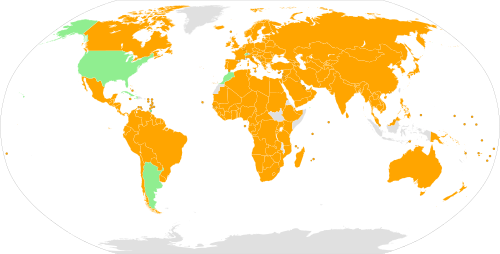 Same disease or problem2005WHO Framework Convention on Tobacco Control (FCTC) enters into forceBoth restricted tobacco marketing, the settlement in the United States and the WHO treaty around the world. The FCTC entry shows binding rules on advertising, smoke-free laws and pack warnings.Read this moment
-
 Same disease or problem1986Surgeon General's report on involuntary smokingThe settlement dissolved industry bodies including the Center for Indoor Air Research, while Koop's report had shown smoke harms nonsmokers indoors. The 1986 entry shows that finding and the smoking bans it supported.Read this moment