Epidemiology
430 BCE
The Plague of Athens
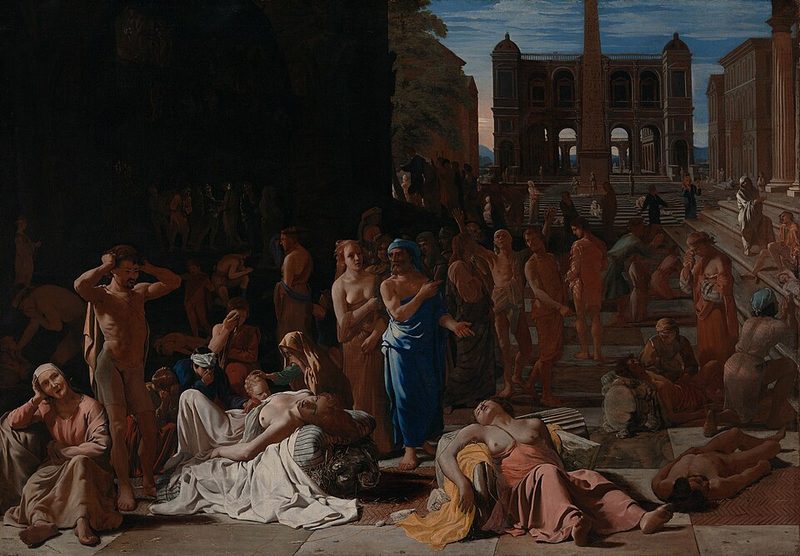
A deadly epidemic struck wartime Athens in 430 BCE. Thucydides, who caught it and survived, described its symptoms, its spread from the port and among those who nursed the sick, and noted that people who recovered were not struck again fatally.
Key people
- Thucydides
- Athenian historian who caught the disease, survived and described it
- Archidamus
- Spartan king whose army was invading Attica when the plague began
Source
Early in the summer of 430 BCE, the second year of the war with Sparta, a Peloponnesian army under the Spartan king Archidamus invaded Attica. Within days a disease broke out in Athens on a scale nobody could remember. It struck first at the port of Piraeus, where people said the Peloponnesians had poisoned the reservoirs, and then moved into the upper city. Thucydides, who caught it himself and recovered, wrote down its course so that it could be recognized if it ever came back.
In people who had been healthy it began with heat in the head and red, inflamed eyes; the throat and tongue turned bloody and the breath foul. Sneezing, hoarseness and a hard cough followed, then vomiting of bile and violent retching. The skin, reddish and livid, broke out in small blisters and ulcers, and the sick burned so inwardly that they could not bear even light clothing; some who had been left alone threw themselves into rain tanks, tormented by thirst. Most died on the seventh or eighth day. Survivors could lose fingers, toes, genitals or eyes, and some lost their memory.
Physicians died fastest, because they visited the sick most, and prayers at the temples did no good. Those who nursed friends caught the disease and died, and whole houses emptied for want of anyone to care for the sick. Refugees from the countryside, lodged in stifling huts in the hot season, died in heaps, bodies filled the sacred places and burial customs broke down. Thucydides also recorded that no one who recovered was attacked a second time, at least not fatally, so survivors could tend the sick without fear.
The epidemic ran from 430 to 427 or 425 BCE. Its cause is still unknown. A 1996 letter in Emerging Infectious Diseases counted 29 or more earlier theories, added Ebola to the list, and suggested testing skeletons from the period for traces of the pathogen.
Keep exploring
 Read next · same disease or problem
The Ragusa quarantine decree (1377)
Thucydides noticed that people who recovered were not struck again, and Ragusa's authorities noticed the same of plague survivors. The Ragusa story shows that idea put to use alongside the isolation of arrivals that gave quarantine its name.
Read this moment
Read next · same disease or problem
The Ragusa quarantine decree (1377)
Thucydides noticed that people who recovered were not struck again, and Ragusa's authorities noticed the same of plague survivors. The Ragusa story shows that idea put to use alongside the isolation of arrivals that gave quarantine its name.
Read this moment
 Today on The Clinical Times
Love to Dream recalls portable baby sound machine over fire and burn risk
Love to Dream has recalled its portable Sleep Machine because its lithium-ion battery can overheat while charging with an incompatible charger, creating a risk of fire and burns.
Read today’s top stories
Today on The Clinical Times
Love to Dream recalls portable baby sound machine over fire and burn risk
Love to Dream has recalled its portable Sleep Machine because its lithium-ion battery can overheat while charging with an incompatible charger, creating a risk of fire and burns.
Read today’s top stories
All 526 moments in the history of medicine. This one is in chapter 1, The ancient world
Connected moments
How this moment links to others in the history of medicine, and what you will find in each.
-
 Same disease or problem1846Panum's study of measles in the Faroe IslandsThucydides saw that survivors were spared a second attack, and Panum proved lasting immunity to measles. In the Faroe Islands he found that people who had measles in 1781 were still immune during the epidemic of 1846.Read this moment
-
 Same disease or problem1546Fracastoro's De ContagioneThucydides watched the disease pass to those who nursed the sick, and Fracastoro later offered a theory of how contagion spreads. His tiny seeds of contagion, able to survive in clothes and linen, shaped ideas of infection for three hundred years.Read this moment